Life Insurance Purchasing the appropriate insurance plan is among the most significant financial choices that one can make. Insurance is not merely a question of covering cash but a question of covering family, future objectives, and long-term fiscal safety. Life insurance and term insurance are the most extensively discussed types of coverage out of the numerous available ones.
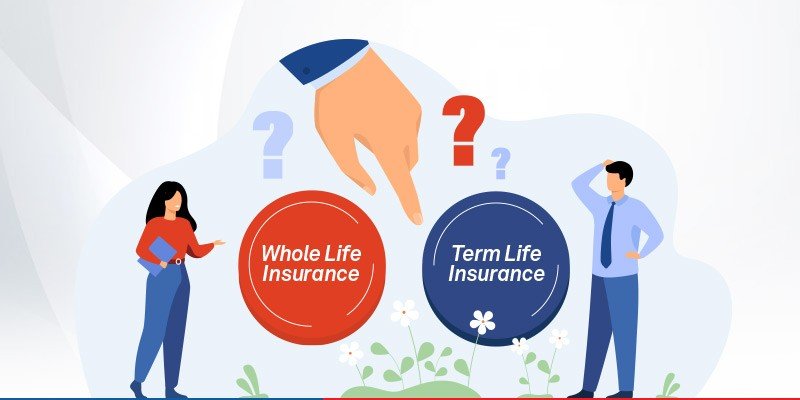
Although they both seek to offer financial security, they are used for very different purposes and appeal to different kinds of people. Before deciding which one to use, it is important to understand how each of them works and what advantages they can bring, as well as with whom they are most applicable.
Life Insurance What You Need to Learn
Whole life insurance, or permanent life insurance, is life insurance and is a long-term policy that covers the life of the insured individual through to his/her death as long as the premiums are being paid. Not only is it a protection plan, but it is also a financial product, which is insurance, savings, and investment. A growing cash value with time is one of the characteristics of life insurance. A part of the premium is invested or saved by the insurance company, and the rest is used in life cover.
This cash is accumulated over time, and the policyholder can utilize this cash in various ways. It is borrowable and can be taken out in case of emergency or to cover big aspects in life like education, investment in business, or retirement plans.
Life insurance is considered to be a wealth-building tool due to the lifetime coverage and savings nature. It is typically applied in long-term financial planning, estate planning, and transfer of wealth. Life insurance is often seen as a safe and sure way by families that are interested in protection and also in financial growth.
Knowing Term Insurance
On the other hand, term insurance is a pure protection plan. It offers life cover over a certain duration term also referred to as a term which can be 5-40 years based on the policy. In case of the death of the insured individual within this time frame, the nominee will get the amount assured. But most standard term insurance policies do not give the policyholder any maturity benefit in case he/she survives the term.
Term insurance is unique in that it is easy. It does not cover savings, investments, and cash value. It is present with a single aim in mind, the financial protection. This renders it very cheap as compared to life insurance. The term insurance is much cheaper, and people can get a high-value cover at minimal expense because of the low premium of the insurance.
Young professionals, parents, and breadwinners choose term insurance as the one that will guarantee their family is financially safe in case something occurs to them during the working years. It is an effective income replacement, loan protection, and family security.
Comparison of Cost and Affordability
The cost of the premium is one of the largest differences between life insurance and term insurance. Life insurance policies are pricier as they provide lifelong cover and a savings or investment facility. The premium does not just cover insurance cover but also helps in value accumulation.
Term insurance is much cheaper since it provides risk cover only. There is no investment or savings factor, and thus the risk of the insurance company is contained within the defined term. This will enable people to have huge coverages at a fraction of the cost of life insurance.
Term insurance is obviously more economical for those having low income or those who desire maximum coverage at minimum cost. The pricing of life insurance is higher but covers the long-term financial worth other than protection.
A Period of Insurance and Financial Objectives
Life insurance is the best in case people desire permanence in their finances. This is because it is throughout the whole life span, and thus the dependents will be provided with financial security regardless of the time of death of the insured individual. This is why it is appropriate for long-term dependents, estate planning, and wealth transfer plans.
Term insurance, though, is more congruent with short-term financial obligations. These are education of children, mortgages, commercial loans, and family dependency in the working age. After such obligations are settled, the demand of the insurance tends to diminish, and term insurance is a rational decision of most individuals.
The decision affecting the two usually lies in individual financial objectives. In case it involves long-term financial planning and wealth creation, life insurance is more appropriate. In case protection in years of financial vulnerability is desired, term insurance better fits the situation.
Flexibility and Financial Control
Life insurance includes the cash value component which provides more financial flexibility. Policyholders are able to get funds when required, borrow the policy, or be able to retire using the policy benefits. This renders life insurance to be a versatile financial tool as opposed to being an insurance product.
Term insurance lacks any financial flexibility either in savings or withdrawals. Nevertheless, it has the flexibility of customization of the cover. Most of the term plans give riders like critical illness cover, accidental death benefit and disability protection, which makes them flexible to the needs of changing life.
Control-wise, term insurance gives one the liberty to invest his/her savings in other financial products such as mutual funds, real estate, or business instead of being tied down to a single insurance product.
Life insurance or term insurance—which is the better one?
No universal response to the question of which one is better or not exists since they are used for different purposes. Life insurance suits better those who desire to have long-term security, savings and wealth creation in a single product. It is ideal for individuals that like stability and guaranteed benefits as well as lifetime coverage.
Term insurance is more suitable in the case of people seeking maximum financial cover at minimum cost. It suits income earners, young families, and individuals with huge financial obligations and require high protection at certain phases of life.
The most intelligent approach is not to pick one or the other: in most instances, the best option is to do both. An individual may take term insurance to have high-valued protection and life insurance to save and plan finances on a long-term basis. This forms an equal financial hedge that takes into account the current risks and future objectives.
Final Thoughts
There is no competition between life insurance and term insurance; these two financial products are complementary. Both of them have their advantages, shortcomings, and best-fit scenarios. Life insurance comes with lifetime security, financial growth, and building of wealth thus it fits the long-term planners. Term insurance is affordable and has high value; hence, it is ideal when covering the future of a family through the crucial financial times.
The best decision will vary according to income, age, duties, financial objectives, and vision in the long term. A question that should be posed as opposed to asking the question of what is better in general, should be; which is better for your life, your family and your future plans?” ” When used judiciously, either of the two policies will prove to be an effective source of financial stability and tranquility in the long run, and both together will be even more effective.